The human body is made up of water and the water intake is very necessary for the smooth functioning of our body. Intake of sugar beverages can lead to health issues like diabetes, therefore, drinking water has always been the first and appropriate choice. Question that arises is that how do you know the water you drink has enough calories, has perfect nutrients your body need and does not include harmful content like pesticide or micro plastics. Most of the Canadians choose bottled water over tap water as they find tap water nasty due to excessive presence of chlorine and many of us believe it just simply tastes bad. Despite the fact that, tap water is regulated by the Federal agency who control municipalities those are bound to check the quality several times a day whereas bottled water is regarded as a food and is controlled under the “Food and Drugs Act” and the water quality is inspected annually. The research has found that bottled water industry has generated $2.5 billion in sales in 2017 and 19% of Canadians used bottled water as a main type of drinking water at their home.
The top companies in the water industry are Nestle, Evian, Aquafina, Fiji and Dasani. In this blog I will be introducing you with the several areas of some of these companies which position them in one of the top companies.
Water source and Quality (Nestle)
In order to retain the consumers and their trust in the company it is very important for Nestle and other companies to provide the best quality that they can. Nestle believes that with the proper management water can be renewed so that it is not available just for today but it is available for future as well. Below are some of the significant areas that they concentrate on to make sure that the quality is not compromised.
Site Selection
Nestle has appointed a team of experts to study the water flow volumes, its quality and its ability to restore. Site selection is done with a deep testing and while considering spring source they look if its healthy and protected ecosystem. The experts make sure that they retain the same properties and quality of spring water is not changed. Due to different naturally occurring factors the spring bestow its unique taste and Nestle employs two Natural Resource Managers in Canada in order to safeguard the spring water sources.
Monitoring
Study of aquatic life, soils, wildlife, and surface water is conducted before they harvest the spring source. Their long time monitoring depicts their efforts in keeping the spring renewable. The collected data from their findings is entered into site-specific databases to manage the spring resources.
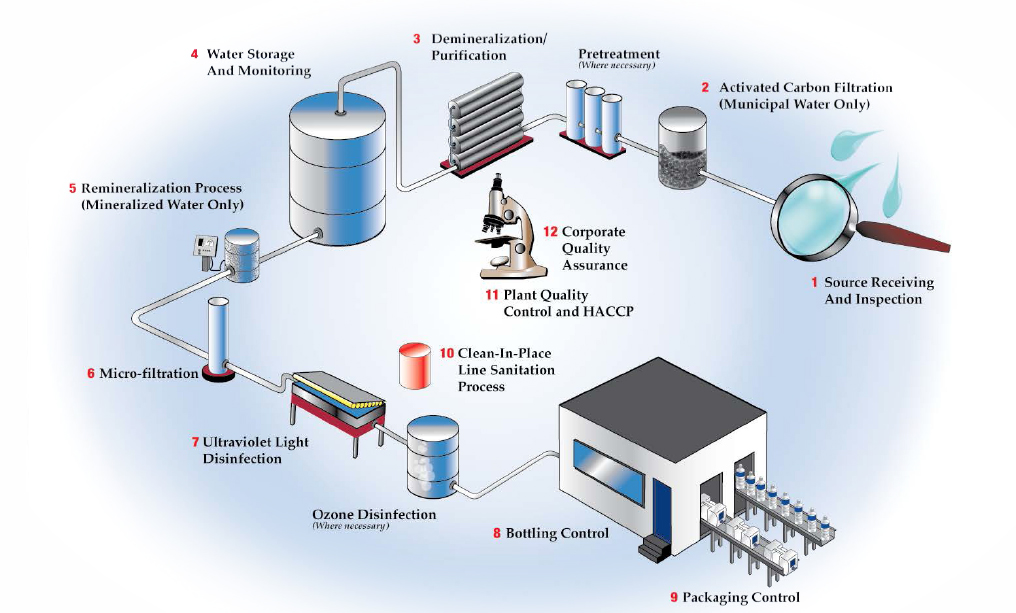
The 10 Quality Step Process
(n.d.). Retrieved from https://www.google.com/search?client=safari&rls=en&biw=1440&bih=837&tbm=isch&sa=1&ei=vcNyXM3FOKPAjwS9tr_gAg&q=nestle water process&oq=nestle water process&gs_l=img.3..35i39.328.3905..4286…0.0..0.482.2327.3j3j2j2j1……0….1..gws-wiz-img…….0j0i8i30j0i24.Y7YHqS78OLI#imgrc=uB6gBogtjgEfNM:
- Source Selection and monitoring: Spring water sources are natural springs that come from aquifers.
- Source water receiving and monitoring: Food-grade pipelines are used to transport the spring water and monitoring of spring water is done regularly.
- Water storage and monitoring: Further testing is conducted to conform with the specifications.
- Micro- filtration: They are used to remove particles as small as 0.2 micron in diameter.
- Ultraviolet Light/ Ozone Disinfection: Designed to destroy bacteria if any present.
- Bottling Control: Filling and capping is done in order to avoid any contamination from the environment.
- Packaging Control: Bottles, caps and labels are carefully controlled, most of the bottles are manufactured on the site.
- Clean-In –Place Sanitation Process: Advanced internal pipe and equipment cleaning methods.
- Plant Quality Control and HACCP Program:Plant processed are monitored
- Corporate Quality Assurance Program: Analysis is performed in accordance with State and Federal regulatory standards.
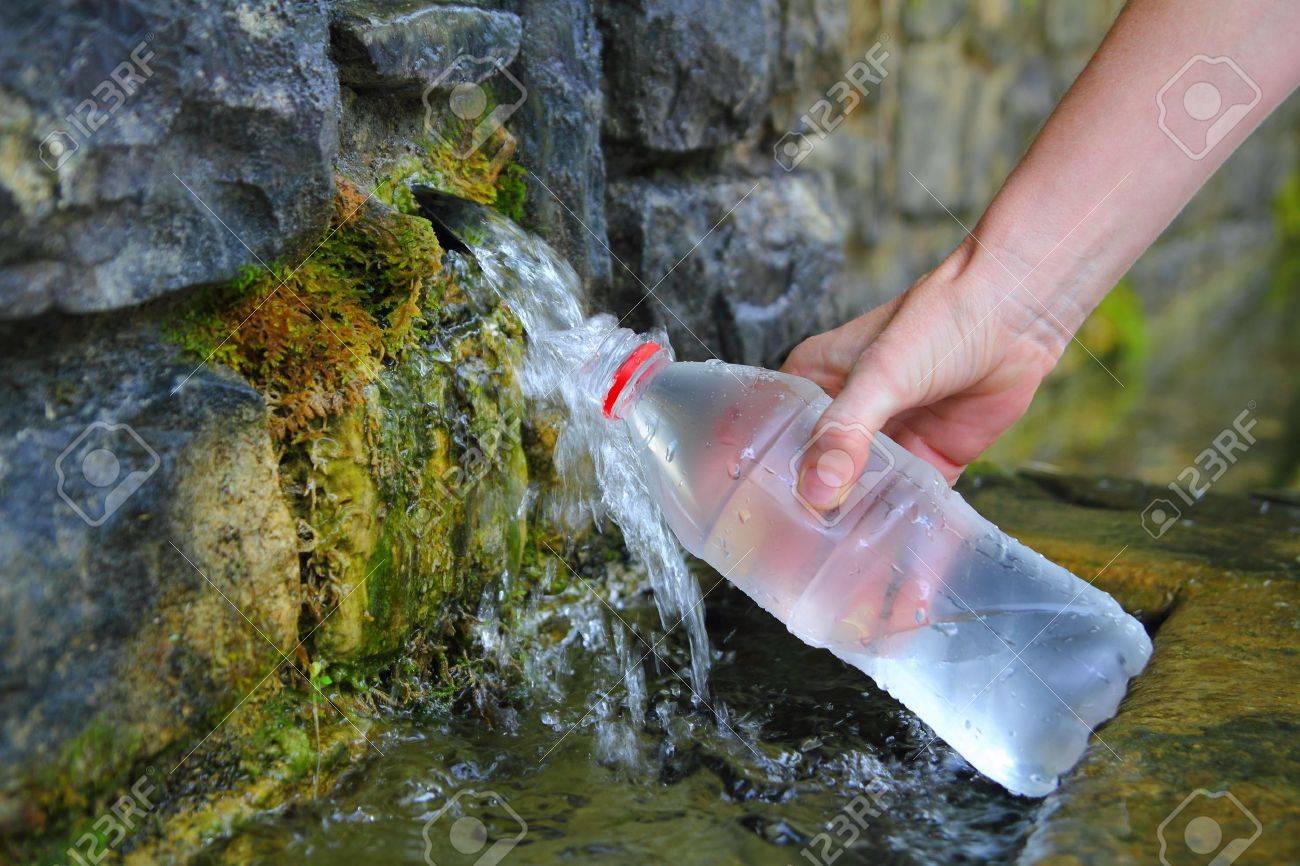
Do they all extract from natural springs?
(n.d.). Retrieved from https://www.google.com/search?client=safari&rls=en&biw=1440&bih=837&tbm=isch&sa=1&ei=HdlyXIvOEOG3jwSr5aiAAQ&q=spring water &oq=spring water &gs_l=img.3..0i67j0l9.13967.15105..15791…0.0..0.247.1023.5j3j1……1….1..gws-wiz-img…….0i24j0i8i30.n9xMadNpHhI#imgrc=6IbbcCIf12_HhM:
Not all the water companies extract and purify the natural spring water. Aquafina use public water sources and purifies using its rigorous purification process. They use the process called reverse osmosis as it helps remove chlorides, salts and other substances that might affect the quality and taste of the water. They have invested hundreds of millions of dollars in purification process and have exceeded the standards of federal government. Even though, all the companies have almost same purification process, Aquafina invests more into it in order to stand out and gain customer’s confidence.
Is spring water same as purified water?
Some of you might be wondering if there exists a difference between spring and purified water, the answer is yes. Spring water originates from underground formation that flows to the Earth’s surface. They are treated to remove bacteria and other contaminants but they can still retain Total Dissolved Solids (TDS), trace compounds and other substances. Whereas, purified water comes from water systems that are regulated by the Environmental Protection Agency (EPA) and provides safe drinking water. Pepsi says Aquafina is a tap water and originated from public sources. They changed the labels to display that Aquafina is a tap water. Aquafina has the lowest TDS reading of 4 as compared to the required standards which says that water should not contain no more than 500 parts per million (ppm)TDS. It is 75% less than the other competitive brands. Aquafina’s purification process does not take out the necessary nutrients out of the water but substances like carbonates, bicarbonates, chlorides, sulfates, calcium, potassium and iron are removed. Even though, calcium is necessary for the human body but their absence in a bottle water does not impact one’s health.
Income generated and contribution to economy by Nestle, Aquafina and Evian.
Nestle is located in Puslinch, Ontario and use water from Aberfoyle and Erin. In Ontario, nestle is currently paying $503.71 per million litres extracted. This will blow your minds when you compare it with what you pay for one bottle water everyday. According to Nestlé Waters Canada’s fiscal year 2017 it contributed $241.1 million to the province and 1181 jobs both direct and indirect with a total labour income of $72.9 million. Nestle also generated $8.79 million in total tax revenue in Ontario. Nestle has paid $1 million property tax and $1.27 million in income taxes paid. In 2006, American bottled water business made $15 billion roughly. Americans spent about $2.17 billion on Aquafina that year. Danone’s the world’s third largest water company introduced Evian. This water bottle has a global market of $198 billion which is forecasted to be $230 billion by 2021. It has always stayed solid in United States and France and in more than 140 countries. The sales grew by 8% in 2017.
Corporate Social Responsibility

Business organizations especially large organizations those who use the resources of the society have the duly to pay back as well. They are socially accountable not just of their stake- holders but to everyone who is affected by their operations. Below are the few commitments of your favourite water companies towards the society that add value to society as well as to their goodwill.
Nestle: Nestle donates cash and in-kind donations equivalent to 1% of annual pre-tax profit. In 2013, they also donated $155,973 in water bottles where their employees work and live. They also promote water education and create awareness among individuals of the society. The quality reports are generated in order to retain the trust. They have supplied water bottles during the floods in Manitoba, Saskatchewan and they have also supplied internationally to Japan.
Aquafina: PepsiCo’s Aquafina reduced the size of labels so that they can save planet from extra plastic. Thus, reducing the plastic by 40%. Even though the business is all about selling water and making money out of it, interestingly they have reduced the size of bottle in order to save millions of pounds of water each year. They have participated in relief work as they donated 40 tractor-trailers to Katrina in 2005 during the hurricanes and in 2007 they sent truckloads of Aquafina to California.
Evian: Evian mainly focuses on water resources, carbon and plastic. They have created an association called Association for the Protection of the Evian Mineral Water Impluvium (APIEME) that help balance preservation of the natural mineral water resource. In 2008, Evian became the first natural mineral water to be recognised as a wetland of international importance by the Ramsar Convention partners of UNESCO. They are aiming to become carbon neutral by 2020.By 2025 they are going to manufacture the bottles from 100% recycled plastic.
The Four most expensive bottle waters in the world
The tap water has become a last choice in today’s world not only because people are worried about the quality of the water but carrying a bottled water has become a little of trend and more of a financial status. You just look rich and stand out when you carry that bottled water you spent money on. Here are five most expensive bottle waters in the world that will blow your mind off.
- Acqua di Cristallo Tributo a Modigilani– $60,000 per 750ml: This water is from France and Fiji
- Kona Nigari- $402 per 750 ml: This water is sold in Japan and is collected from Hawaii.
- Fillico- $219 per 750 ml: These water bottles are topped with golden crowns associated with royalty.
- Bling H20 – $40 per 750 ml: This bottle is designed as bottled of champagne.
References for cover photos and sites used
(n.d.). Retrieved from https://www.google.com/search?q=nestle water&client=safari&rls=en&source=lnms&tbm=isch&sa=X&ved=0ahUKEwjniY-e_9TgAhWs7YMKHfo7CSoQ_AUIDigB&biw=1440&bih=837#imgrc=Im_pE1zzgnsU9M:
(n.d.). Retrieved from https://www.google.com/search?q=tap water&client=safari&rls=en&source=lnms&tbm=isch&sa=X&ved=0ahUKEwjr48TO_9TgAhXL1IMKHeMcBkIQ_AUIDigB&biw=1440&bih=837#imgrc=KqB15Y4eXvOOqM:
Planet. (n.d.). Retrieved from https://www.evian.com/en_int/planet
(n.d.). Retrieved from https://www.google.com/search?q=corporate social responsibility&client=safari&rls=en&source=lnms&tbm=isch&sa=X&ved=0ahUKEwjP896D_tTgAhUl8IMKHfRvCxYQ_AUIDygC&biw=1440&bih=837&dpr=2#imgrc=jG7xFFqJ5ZzDbM:
Our Sources. (n.d.). Retrieved from https://www.nestle-waters.ca/en/water-sources-n . quality/our-sources
Management. (n.d.). Retrieved from https://www.nestle-waters.ca/en/water-sources-n-quality/our-sources/management
Site Selection & Monitoring. (n.d.). Retrieved from https://www.nestle-waters.ca/en/water-sources-n-quality/our-sources/site-selection-monitoring
Our Water Processes. (n.d.). Retrieved from https://www.nestle-waters.ca/en/water-sources-n-quality/our-quality/our-water-processes
Planet. (n.d.). Retrieved from https://www.evian.com/en_int/planet

 Bottled Water Business